Nov 05 2007

The Dietz Rebuttal - Jelliff or Schrenkeisen?

Published by RareVictorian at 11:03 am under Best Of

Michael O’Docharty reminded me of the letter that Ulysses Grant Dietz wrote to The Magazine Antiques in response to the 1999 Anna Tobin D’Ambrosio article that I mention in this prior post. Dietz was curator of Decorative Arts at the Newark Museum in Newark, New Jersey at the time (don’t know if he still holds the position). His response is here and worth a read if the Jelliff/Schrenkeisen article topic interests you. To net it out, he believes that the Schrenkeisen Grand Duchess line of furniture was probably actually a Jelliff set that they were reselling under their own name as a kind-of “high line” of furniture.

Dietz asserts that:

“I was struck by the Jelliff-like parlor suite pictured, particularly the fact that this furniture was of a distinctly higher caliber than the bulk of what Schrenkeisen was offering. I concluded then, and maintain still, that Schrenkeisen must have been a wholesale outlet for Jelliff.”

He is speaking of the Grand Duchess in the 1872 Schrenkeisen catalog. I personally don’t see that there is such a quality disparity between the Grand Duchess and the rest of their wares. It was better than much of their furniture lines yes, but not the carvings in the sofa back for the No. 17 Divan, the crests on “Marie Antoinette No. 41″, Set No. 59, and especially “Fine Parlor Set No. 60″ from the catalog. They are of similar quality from my perspective.

I don’t believe that the inclusion of Jenny Lind carvings in the Grand Duchess set constitutes higher caliber. Jenny Lind carvings were pervasive at the time, in all levels of furniture quality, from any number of makers. That is the only element that I can point to that Dietz could be focusing on to suggest higher quality. Much of the surrounding ornamentation is of equal caliber in all those sets. During that time period, furniture makers could probably buy a component Jenny Lind carving from a parts supplier as readily as we buy dowels at Home Depot today.

I also don’t believe that Dietz would see the Jelliff chair on page 51 of his “Century of Revivals” book as exemplary or of superior work to Schrenkeisen. It is a confirmed Jelliff piece (made for Jellif’s own daughter) but it is simple, save for the carved man arms.

Dietz asks the question, and I paraphrase, “if these are all Schrenkeisen’s work, what the heck did Jellif make then”? I say he made sets of this caliber (below), which coincidentally have the same carved man arms as the Jelliff chair mentioned above:
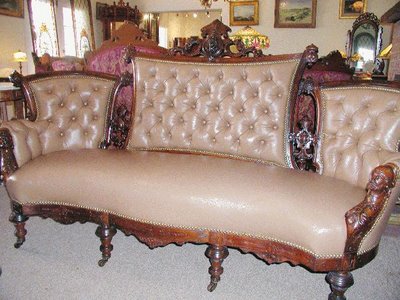
 The Dietz Rebuttal - Jelliff or Schrenkeisen?
Which if you compare to the Grand Duchess, is certainly more sophisticated.

To further answer his question, I have these thoughts:

  • Jelliff used Rosewood as well as Walnut. I don’t see any Rosewood Schrenkeisen work in the catalogs, nor mention of it as an option. If Schrenkeisen did Rosewood I would think it would be mentioned in the catalog explicitly since they go out of their way to point out the French Walnut panels on the higher-end sets. I have seen attributed Rosewood Schrenkeisen chairs, but these are the contested chairs in these articles.
  • I also do not see a single sofa with 4 front legs in the Schrenkeisen catalogs.

Dietz reasons, reasonably so, that Jelliff may have wanted a big player to expand his reach. I think I lean more to D’Ambrosio’s reasoning that it isn’t the case. I think Jelliff (a high-end maker) would have unlikely sold at sub-wholesale prices to a mid-level wholesaler. That would have been a very tight margin for Jelliff.

I don’t personally take a side on this debate as I see no “smoking gun” to end it. I also have only seen pictures of the pieces in question. I have not seen them in real life - so there may be quality levels in the carvings that need to be seen live. I think the only thing that would lead in the direction of solving it would be to acquire access to the original business ledgers of Schrenkeisen and/or Jelliff and see if there are payments in either direction with details on the transactions.

To further complicate this mystery for me, here are pictures of a chair that I own that has the Schrenkeisen Grand Duchess form, but it is made of Rosewood. The legs are also extensively carved and not simply turned as the Grand Duchess chairs are. The arms are carved with a figure of a sea serpent torso. The crest has a flat burl panel that I have not seen in similar chairs.

122_2279005005-764090 The Dietz Rebuttal - Jelliff or Schrenkeisen?
122_2280004004-777700 The Dietz Rebuttal - Jelliff or Schrenkeisen?

Related items for sale - hover mouse for more information

gorgeous-american-antique-victorian-bedroom-suite
460229--pair-antique-italian-tuscan-style-sideboards
antique-french-renaissance-carved-buffet-romeo-juliet
set-4-antique-french-barley-twist-hunting-dining-chairs
antique-american-rosewood-desk-by-john-jelliff
it4439--antique-italian-renaissance-revival-hall-tree
870042--antique-italian-renaissance-revival-sideboard
antique-victorian-john-jelliff-walnut-couch-sofa
renaissance-revival-w-bronze-mounts-&-marquetry-cabinet
american-renaissance-revival-walnut-octagonal-table
pair-of-antique-victorian-john-jelliff-walnut-chairs
nice-antique-french-henry-ii-carved-walnut-set-6-chairs
french-antique-breton-armoire-media-wardrobe-cabinet
antique-art-nouveau-bookcase-display-china-cabinet
antique-renaissance-revival-walnut-marble-top-table
More Victorian Antiques ...


Get Our Updates By Email | Add to Your RSS Reader | Email This Post Email This Post


Tags: , ,

Trackback URI | Comments RSS

Leave a Reply